LEDE ON
By this point last year we had four significant camera introductions. This year, none. Every company I talk to quietly confirms that their original plans for this year have all been pushed later and later, to the point where some off-the-record-but-honest responses tend towards “we don’t know when our next big product intro is going to appear; later this year is our best guess.”
The AI elephants in the room have got all the mice scrambling for floor space. When I talk to my supply side friends, they all tell me “100% of what we’re shipping is going to AI demands.” That starts with chemicals and wafers, and ends with completed chips. I’ve been told that even Apple is scrambling to keep their supply chains going full steam. So to continue the analogy: even the cape bufallo is finding the room crowded and difficult to navigate.
This isn’t going to let up in 2026, as the current stated plans of the AI elephants indicates that they'll want even more of the room in 2027. Meanwhile, we’re in the midst of key top management planning time in Tokyo, as the end of the fiscal year for all but Canon at the end of this month triggers final consideration on how to make the coming year better. Through the grapevine I’ve heard a couple of the ideas being considered in Godzilla’s stomping grounds. Those won’t work. Godzilla will still stomp them (oops, my keyboard seems to have substituted a new metaphor!). The ideas that might work at keeping sales numbers up are (a) more significant firmware updates; (b) better marketing, particularly in customer education; (c) deeper targeted discounts that aren’t 100% on repeat but linked to (b) and (d); (d) event-driven customer experiences; (e) bundle parties (cameras plus lenses producing discounts); and (f) making a louder splash when you do have a significant new product to introduce.
But a new great camera with a new sensor, new ASIC, lots of updated features and performance, that will make you run to the store to see it? We’ll eventually get a couple of those this year, but they’ll be later than expected, and probably available in lower volume than demand. I doubt those few new key cameras will move sales numbers much.
——————————
Report
WPPI 2026
Once again I attended the wedding and portrait oriented show for professional photographers that occurs each year in Las Vegas. I went mostly to keep in touch with what’s happening in an area of photography that I don’t generally practice, but also because I’m working on a book that has a section on lighting, and lighting and posing are the two headline ingredients at the show. It’s not that I don’t know light, having lit my first studio in 1973, it’s that running full lighting setups is not something I do every day, and I wanted to make sure that I’m not fogetting something as I write new material.
I’m not going to get too into the WPPI details here—if you have a specific question drop me an email and I’ll try to answer it—but I did have a number of observations as I attended sessions, took photo walks with instructors, and browsed the large trade show of gear and services that runs alongside the educational components:
- The back of the camera is the primary compositional choice. I mentioned this last time I wrote about WPPI: most photographers here simply compose with the Rear LCD. There were a couple of holdouts. Mostly old-school names you’ve heard before who started with SLRs, used DSLRs, and now treat their mirrorless systems the same way (see Joe being Joe, below). But the younger crowd would be quite happy with the viewfinderless ZR, and I saw quite a few of those around the show. As I’ve noted before, when you’re dealing both with your camera and someone posing in front of it, hiding behind the viewfinder tends to break the connection between you and your subject. Connecting with your subject is how you help interact with them and adjust their pose.
- CaptureOne is the tether choice. Virtually every live demonstration (of which there were hundreds) had the camera tethered into a MacBook running CaptureOne. A number of presenters even went so far as outright claiming “CaptureOne is the only reliable choice" for tethered work. I never saw a hitch with a CaptureOne tether in any session, though there were lighting and audio hitches, so maybe there’s some there there to that claim. Also: almost everyone was using some of Tether Tools bits and pieces (e.g. cabling).
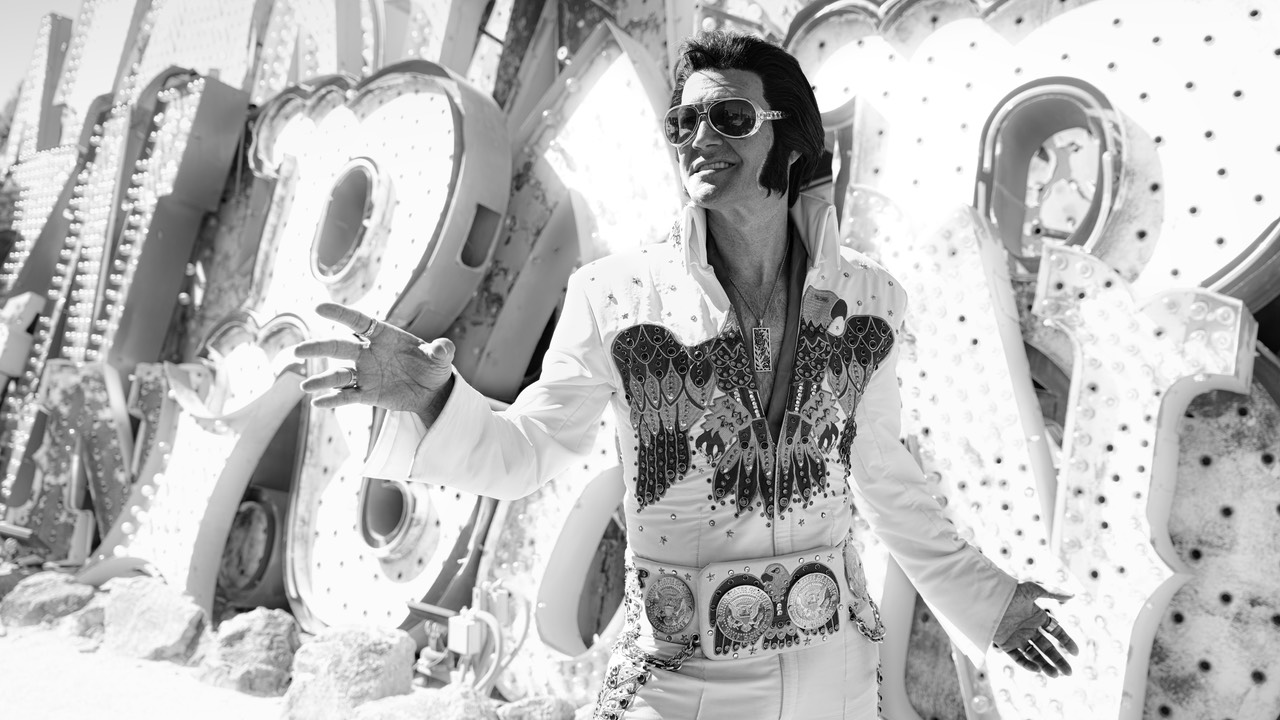
- Creativity is not dead. On a Fujifilm walk with a monster combo of GFX100II and 20-35mm f/4 lens in hand, instructor Chris Berry told me to “break the camera.” Not literally, of course. But rather stop doing things the way I usually do. It’s true, as a raw user, I don’t tend to break outside of long-considered exposure norms. So I grabbed Elvis, cranked up exposure compensation to +3EV, dialed in a filtered Astia+G, and took the image at the head of this section. Not. What. I’d. Normally. Do. And that was sort of the point Chris was making: the creativity you need to stay afloat in this business comes from pushing boundaries, trying new settings, and “breaking” things. Indeed, that’s one of the places that “personal style” comes from. When Insta was new, running a filter on your capture was the thing that set an image apart and possibly stopped a doom scroll (to some degree, still does). But if in going outside the usual box you start finding something you like and that tests positive when you show your images to others, then you’re doing the right thing. Ultimately, photos are to be looked at, examined, maybe even studied and analyzed. If your image looks like every other one out of a Canikony at default settings, it would be incredibly difficult to sell your photography to others as a service. WPPI has thousands of attendees who are making money off of photography. One reason they do is that they keep tuned in to what’s happening on the “creative” side. (And yes, that image is +3EV in exposure. At the end of this news story, I’ll show you how I processed it to get closer to what I was thinking. But it’s pretty incredible what the Medium Format image sensors can hold in terms of dynamic range, and the level of detail at 100mp is pretty amazing. The above image in its original form would print 37” on the long side, by the way.)
- But don’t forget to do what sells. Another speaker went through the process of “breaking” something to demonstrate images that catch attention, but he runs a production studio and keeps careful track of his actual sales. He reports this: the creative images pull people into the studio, but customers still end up choosing to buy the more traditional ones. So make sure that you’re still giving them that option. This plays into something I learned when doing editorial work for magazines: (1) the magazine was attracted to me because of a style/look I produced; (2) they asked for images specifically that fit their style/look and tended to run those over (1). But every now and then, my style/look won the call, which triggered other magazines to ask about my availability. Put another way: do what sells, but also do more. That more should be unique to you and the result of your creative process going further than what you were asked for.
- Speedlights are too old school to consider. Virtually no one was using camera-company flash units. The standard in most demonstrations was Profoto A2 and B30 strobes. A few used the lower cost Godox (or Adorama Flashpoint) similar lights. The first reason the on-camera flash units get no love is output: you get more light from the big rigs. The second is ease in “modification.” Soft boxes, grids, gels, and more all work very simply in the current Profoto designs, and are extremely fast to set up and/or swap out. When you really want to control the light as do the portrait and wedding photographers, you need a lot of power, up close, and softened. Of course, a full three-light and modifiers Profoto rig is going to set you back US$6000+, and you still need stands to put the lights and modifiers on. So it’s a tough sell. But instructor after instructor kept making it look easy, so I’m sure Profoto made quite a few sales.
——————————
Report
Joe Being Joe
I’m always up for watching Joe McNally in action. He tends to start out from a tame starting point that isn’t a lot different than the rest of the pack, but as he starts working a scene his special powers start heating up and next thing you know you’ve got a juiced up Full Joe running around the room. A good case in point was his presentation at the Lighting Summit, where, like most of the other instructors he began with “a model and three lights” and did the usual things with them. Here’s Regular Joe making soup:
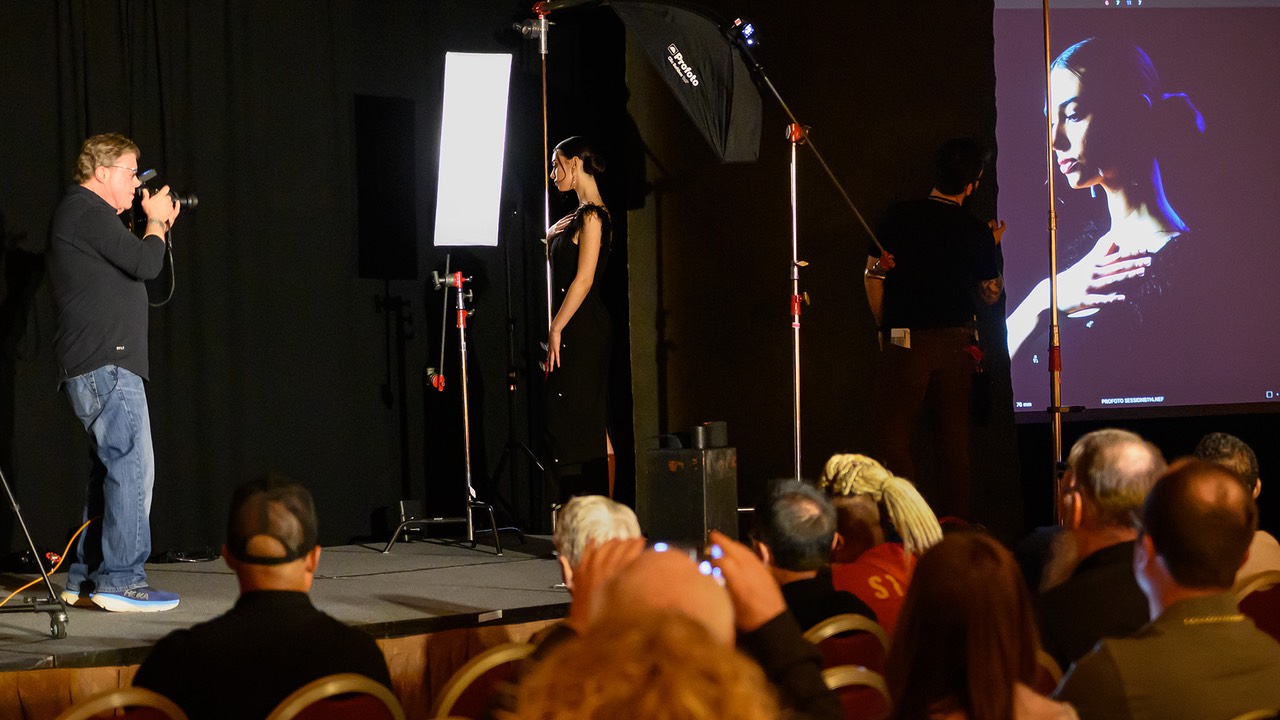
You see Joe at the left, his model and some of the lighting in the middle, plus the result of the image he just took via the CaptureOne tether on the far right. (Pardon the exposure here; there’s virtually no ambient light in the room, and I have no control over the stage light or the projector. If you’re wondering: Z50II with the 16-50mm f/2.8 lens at ISO 6400 to 12800 on these images, as I’m using a slowish shutter speed to keep the frequency-based ambient lighting from throwing color bands and drifts.)
At some point as he’s working, some secret chemical starts getting dispersed into Joe's bloodstream and he begins building his superpowers. At some point he'll wonder if he really wants to just make soup any more. Maybe a spicy salsa, stew, or curry instead? I mentioned the “creative” side above, and one aspect of that is noticing things and another is not self-editing. These are things that the superpowered Full Joe does in spades.
Eventually Full Joe jumped off stage with his model and one light, started interacting more with his model asking her to do nontraditional things (acting!), raised the light over her head, engaged the audience in what he was thinking, and ended up with this setup:
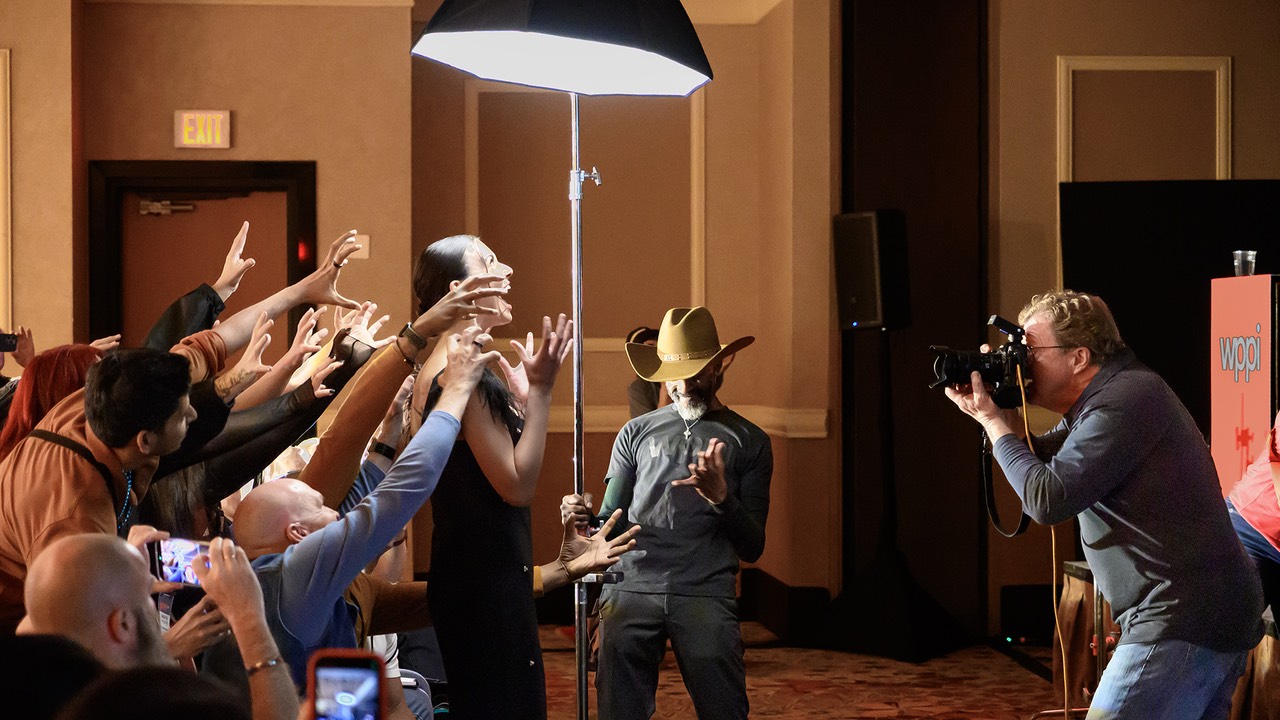
And here’s what came out of his camera into CaptureOne:
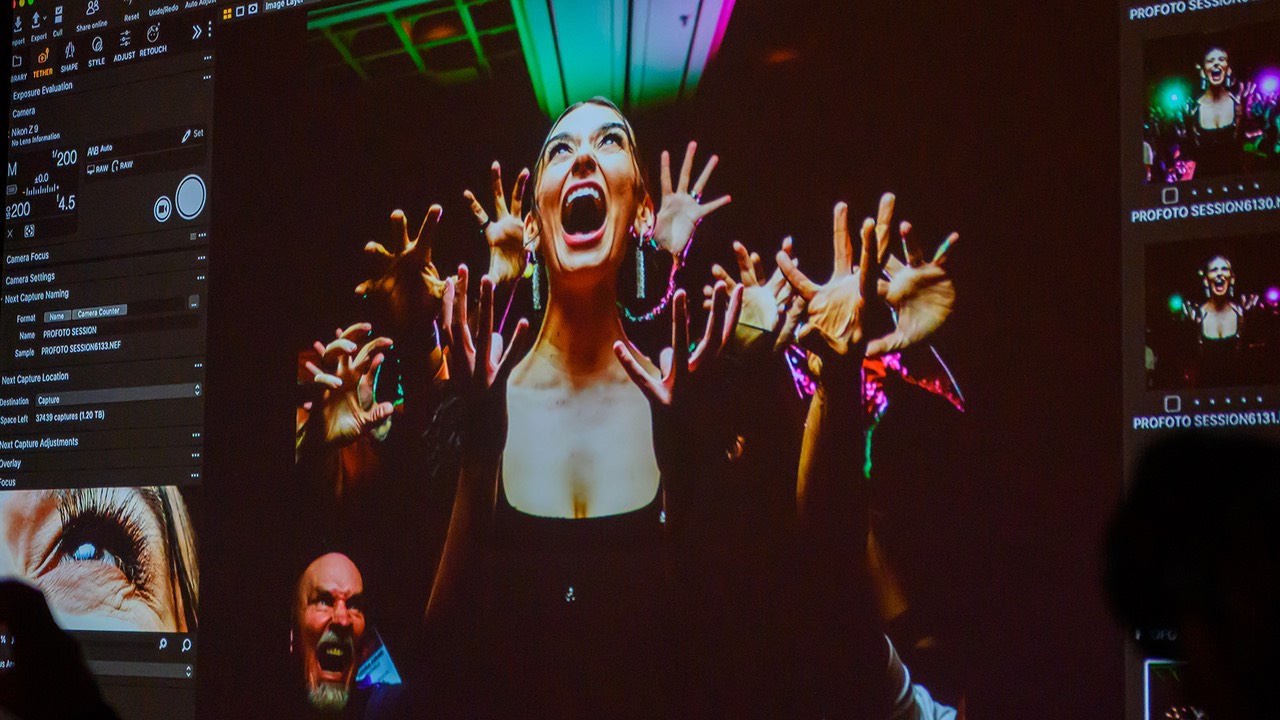
The strange ceiling light and some of the backlight color comes from the fact that Joe added two Profoto A2’s with colored gels behind the audience and pointed them straight at the camera (you can see them on the previously taken images on the far right, before he repositioned himself and the model so that the lights didn’t appear directly. Again, this is me taking a photo of a screen showing the CaptureOne tether, so I have no control over the color and contrast. The actual image looked far better on Joe’s laptop, obviously.
Joe being Joe, he also spouted something new I hadn’t heard him say before, and that’s about aspect ratio. Basically Joe says he’s mostly using 1:1 as his aspect ratio now because then he never has to turn the camera on its side. So much for vertical grips.
One of the things I’ve been planning to do with byThom MAX is cover conferences and trade shows more extensively, including new things such as video, interviews, live streaming, and more. But the infrastructure for byThom MAX isn’t done yet, so you’ll have to settle for today’s abbreviated text and photo sample. I want to “always be teaching” in MAX form, so expect me to venture into that in new ways.. Who knows, maybe I’ll become the world’s oldest TikToker.
——————————
Z Versus China
It seems clear that Nikon has gone completely cease and dissist on Chinese Z-mount lenses recently. The Viltrox suit coupled with letters from Nikon lawyers makes that perfectly clear. Many of those Chinese lens makers (or at least their US distributor) were at WPPI, so I spent time there asking the obvious questions.
No one would talk much in the way of specifics, but the generality was pretty much always “we’ll still be selling Z-mount lenses in the future.” I did note that the ones that seemed the most nervous and vague about what’s going to happen were those with “performance” autofocus lenses. E.g. Viltrox, but not Laowa.
Which brings me to a hypothesis. Nikon has a dozen or so patents surrounding the Z-mount. Some of those are size and physical attributes, which almost certainly wouldn’t hold up to scrutiny in court and can be easily reverse engineered in a clean room. Others are extensions of the F-mount protocols, which have been known and used by third party lens makers without Nikon’s permission for decades now. It would be difficult for Nikon to assert those F-mount patent specifics now, as they’ve not done anything I can see to protect that information in the past. The FTZ adapter pretty much proves that Z System cameras still understand and can use F-mount protocols, when necessary, as the FTZ turns out to be nothing more than a signal pass-through for the most part.
Which brings us to the Z part of the Z-mount communications. For instance, there’s a second synchronous serial data stream now, and that appears to be there to manage better focus performance. Nikon is just starting to unleash that themselves, and I believe that one of the Z9II’s new features will be related to that new channel, as well. You have to ask yourself, for instance, why do the 24-70mm f/2.8 S II and 70-200mm f/2.8 VR S II focus faster? Yes, some of that’s the new SilkySmooth focus motor system. But I believe some of the faster focusing is due to specific Z-mount protocols, and that will become clearer with the next generation of cameras from Nikon.
Viltrox is also entering into the “focuses faster” realm now with their PRO lenses, and my hypothesis is that Viltrox has now picked up on something beyond the base F-mount protocols and are implementing this on their lenses. Couple that with Nikon completely missing their lens attachment rate goals (2:1 was the stated goal, they’re getting <1.5:1 out of China), and it seems that Nikon sees the problem being a financial one, which is the reason that it now appears that they’re asking for mount licensing fees.
Coupled with this is the entreprenuerial nature of the China lens market. There’s a lot of cross licensing, design sharing, and engineer movement going on between the various Chinese lens companies. So knowledge about what works and what doesn’t is getting shared very rapidly among the Chinese lens producers. This suggests a couple of things: Viltrox is the first to be sued because they are the ones showing the most impressive growth and now starting to nibble into the arena where Nikon S lenses play, but the entire Chinese lens market is learning from Viltrox, thus the warning salvo of cease and dissist letters.
I’m not against Nikon asking for companies to sign mount licenses and even paying FRAND (fair, reasonable, and non-discriminatory) royalties. However, the way Nikon is going about things and the fact that they haven’t communicated to Nikon customers what they’re doing and why is just clearly a bad business decision getting badder by the day. All this in a year when there won’t be a lot of new camera announcements from them, too.
I’m starting to see this as a “make or break” year for Nikon. Either they remove these frictions, launch a successful Z9II and some key lenses of their own, plus figure out how to move more units through dealers, or they don’t, don’t, and don’t. In the “make” case, Nikon will see sales growth and some market share increase to continue the positive path they’ve been on. In the “break” case, Nikon will lose some customers and find themselves in a deeper market share war with Fujifilm for third place, with the potential for dropping to #4.
It’s probable that top management and the legal team in Tokyo don’t believe any customers see any of this legal action. They’d be 100% wrong. It’s possible that top management thinks that customers won’t be concerned about any of this legal action if they did know about it. That would also be 100% wrong. Nikon needs to resolve the mount license situation quickly, and the basic way to do that is FRAND patent licensing coupled with making a clear announcement about that.
-------------------
Wrapping Up
And in other news
▶︎ Apple adds Neo, updates other MacBooks. It was a big week for Apple in terms of updates and discontinuations. I won’t be updating my full Mac advice articles on this site until I deploy the new site design, so we’ve got a lot to cover here in short form:
- Discontinued: MacBook Air M4 (13 and 15”), MacBook Pro M5 (13” with 512GB SSD), MacBook Pro M4 (14 and 16”), Mac Studio M3 Ultra with 512GB memory, Studio Display A13, and Pro Display XDR. Many of these are great products for photographers and are seeing discounting as retailers try to get rid of their inventories. Don’t be afraid to buy those that I recommend.
- Added: MacBook Neo, MacBook Air M5 (13 and 15”), MacBook Pro M5 (15”) with expanded SSD, and MacBook Pro M5 (14 and 16”) with Pro and Max chip options, two new Studio Display options (regular and XDR).
There’s a lot to unpack. First, generational speed gain is about 15% from M4 to M5, all else equal. While that sounds modest, as you move into the advanced versions (Pro and Max) some of the core changes may make more of a difference, if utilized. That said, most of you won’t notice the difference between M4 and M5 performance, all else equal.
Let’s start with the MacBook Neo. It’s very tempting as it has a low starting price and doesn’t give up a lot to get there. But I won’t be recommending it to photographers because the storage limitations (max 8GB RAM, max 512GB SSD) are too constraining. It’s not that the Neo can’t do Lightroom/Photoshop, it’s that you’re almost immediately into the Ram Doubler-like compression and swapping as you work on images, even 12mp ones. As you start to do more, you’ll wait more. I just don’t see a Neo being able to grow with you as you start taking and processing a lot of images. If anything, you’ll chew through the life of the small SSD fairly rapidly with all the swapping going on. The more megapixels your camera has, the more you’ll feel that.
On the other hand, Apple did something I 100% approve of with the new MacBook Pros: 1TB is now the minimum SSD size. For a prolific photographer I’d still recommend storing your images on an external drive, but this larger built-in drive size is no longer likely to get in your way of storing your catalog, cache, and swap files. A base level 14” meets all of my basic requirements for a photographer’s laptop now and lists at US$1699. I’d still consider upping the RAM to 32GB, as RAM=performance in the Apple Silicon world. That extra RAM will add US$400 to the cost, though. But the result would be a wickedly good machine that travels well and should last you for some time. You can still go crazy upgrading a 14” MacBook Pro (or 16”), getting you all the way to US$7049 (M5 Max, 40-core GPU, 128GB RAM, 8TB SSD, nano-texture display). But at that extreme you’re deep into “competes with highest-end desktops” performance, and I’m not sure why most of you need that in a portable. (Disclosure: some of us do. I have a MacBook Pro M4 with 64GB RAM and 8TB SSD, but that’s because I need my desktop when I travel.) What I’d suggest to all those considering the MacBook Pro is to look at sales on the M4 models, but definitely not be afraid of the lowest level M5 models.
The MacBook Air is somewhere between the Neo (not a great photographer tool) and the MacBook Pros (superb photographer tools). We now have 13" and 15” Airs with M5, 16GB, and 512GB SSD starting at US$1099 and US$1299 respectively. If you want a really excellent option, pick the 15” M5, 32GB, and 1GB SSD at US$1899. That’s not going to have issues with Lightroom or Photoshop, give you some growth space, and provide excellent performance for virtually anything you might do.
Meanwhile, the Apple external display choices need to be noted: the basic US$1599 Studio Display didn’t reallly change, it mostly got an updated A19 chip at its core (the original was A13). The more expensive Studio Display XDR is where changes came: downgraded from 32” and 6K to 27” and 5K, and updated to A19 Pro chip with a built-in camera. The XDR version is now “only” US$3299, though. Note that neither of the new displays work with Intel-based Macs; we’re in an Apple Silicon world now.
All in all, Apple is pushing Mac very rapidly in capability and performance that now provides workstation-level ability in a highly portable form. Apple’s not done with Mac for the year, but this first salvo is pretty darn awesome. Somehow Apple has kept a lid on their pricing (with a little juggling) while continuing to push performance at a high pace. The MacBook Neo’s an insane machine for its US$599 price if you’re just looking for a computer to do Web, email, office productivity, and other basic chores. But it’s not quite enough for an active photographer on the road; the base MacBook Air would be the better choice.
———————————
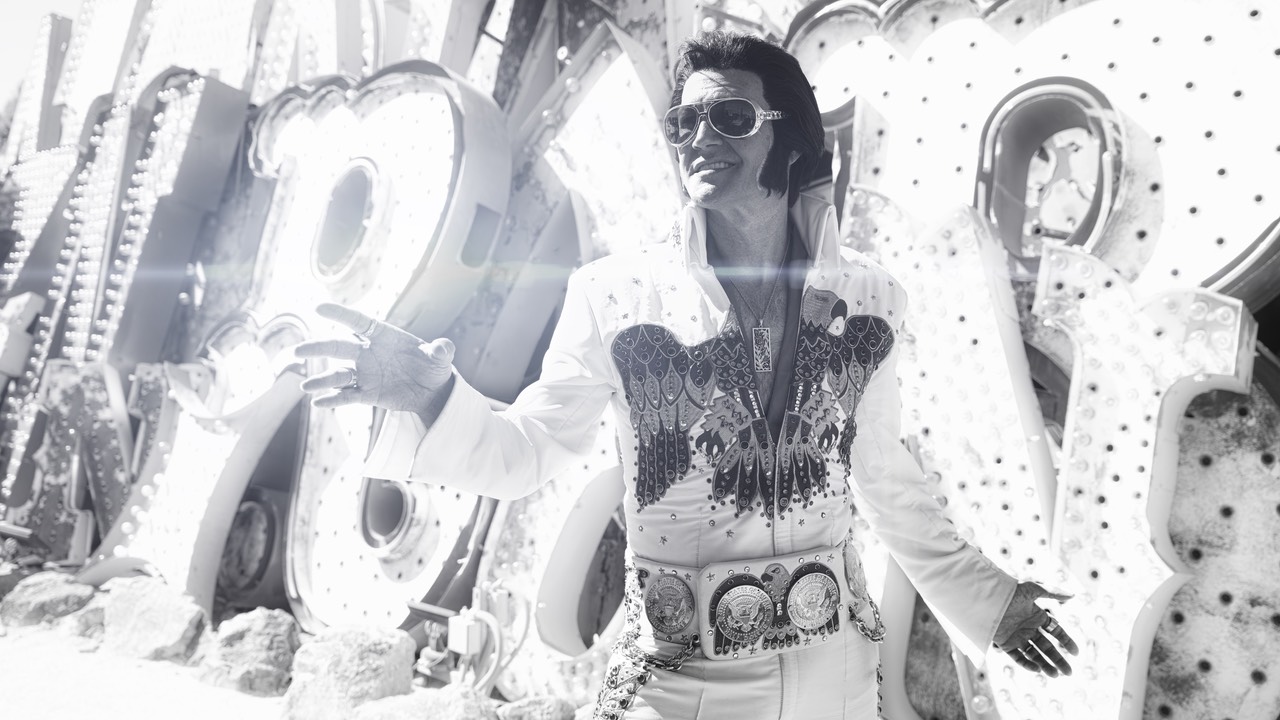
As promised, here is the start of one of my “processed” versions of Elvis. The primary difference is that I’ve applied so far is an anamorphic flare. What I was thinking about as I was “breaking” the camera was “Elvis wears white and he’s in heaven and I’m at the museum where all the old Vegas neons goes when it dies,” so I want an all-white, almost heavenly look.
So what I’m doing here is breaking Photoshop. It needs a lot more breaking to get to what I was imagining, but now you might be able to see where I’m headed. I need to get home and work on this with the big computer some to do what I want. The flare needs to go behind Elvis and I need more flare effects. It’s difficult making these decisions on a laptop.