Bear with me for a moment, I'll get to the point while first tip-toeing around it.
One thing that's not been talked about in relation to the COVID-19 pandemic is something very fundamental and important. When all was said and done, the GDP (gross domestic product) shrank less than did the job force still employed. The reason? Businesses used the crisis to jettison their least productive workers. To put it bluntly: can you stay in business and be profitable with 10% less sales but 20% fewer workers? A lot of businesses said yes to that.
What's that have to do with photography?
I've already noted elsewhere that we're slowly losing camera dealers, which means that camera companies will have to be more efficient in how they sell products in the future. But no, even that isn't not what I want to discuss today.
I want to discuss your GDP. I define that as your Gross Digital Product.
Back when I was an undergraduate I photographed college athletics for ABC Sports. For any event I was assigned, I tended to produce four to six rolls of film (or 144-180 frames). My goal, and what kept me employed, was that 10% of those were "keepers." Literally. The rest never made it into the ABC files, weren't coded, weren't stored, never appeared in media, and were literally thrown away.
So my Gross Film Product Per Game was 14 to 18.
Today I photograph sports with digital cameras. The direct costs of taking more images per event are zero, so it isn't unusual for me to take 500+ images per game.
However, the indirect costs of creating more images are not zero. It takes time to ingest, browse, select, process, and transmit each image, so I don't want to be indiscriminate about how much I photograph in a game. Otherwise I could be taking thousands of images per game.
Most of the time, I'm delivering about 100 images to a client per game (or ~20% of what I took). I'm not always sure how much they're actually using and keeping, so I can't say my "keepers" percent has improved. But at best case it will only be 20%.
One thing I try to always do is ask the client beforehand what images they really want, what they'll be used for, and how they'll be used.
With sports, that almost always results in an answer of "jubes" for social media. That's short-hand for jubilation photos. For baseball, no one still wants to see the ball coming off the bat for the winning, game ended home run (though I photograph it and provide it); they want the celebration of the home run hitter being greeted by teammates at the plate.
This has changed positions that we take photos from. These images, for example:
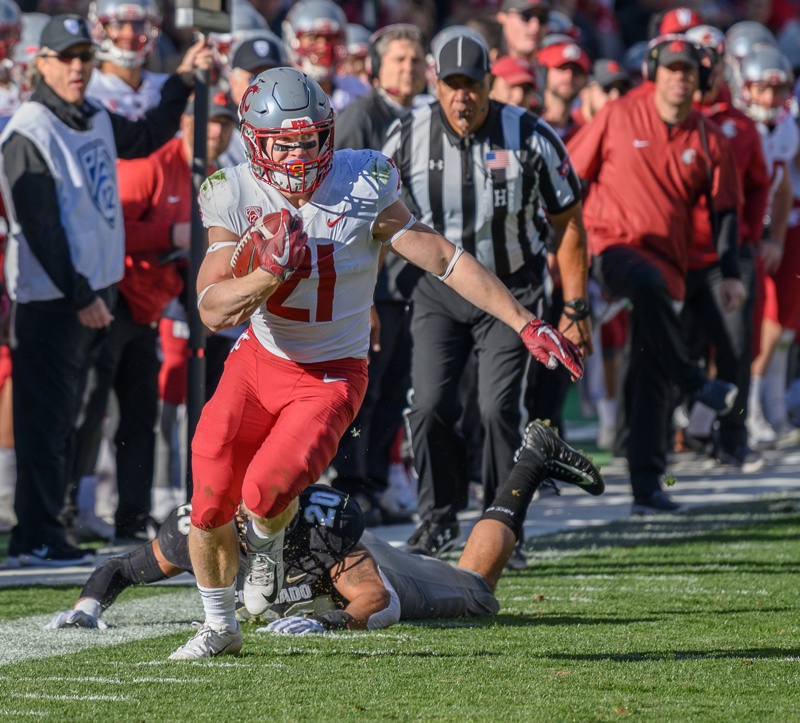
Yes, the team wants individual action, and this was the receiver making a key move that resulted in a touchdown. But here's the image they wanted:
Yes, the team wants to get individual action photos, and this was the receiver making a key move that resulted in a touchdown. But here's the image they really wanted, and wanted instantly:
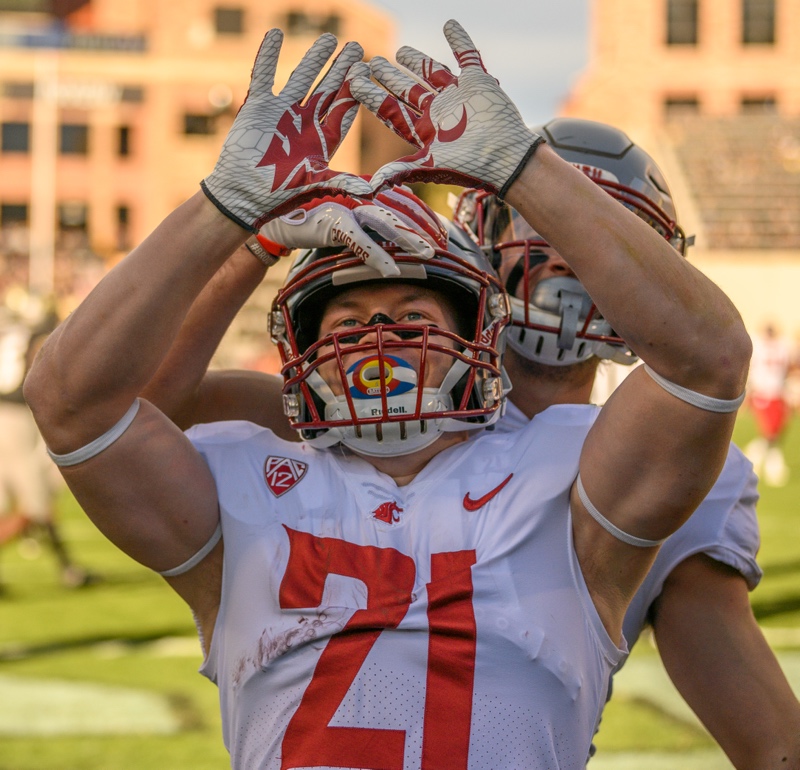
The post-touchdown jube.
I'm positioned right next to the ESPN end zone camera. I was literally leaning against their platform.
Why? Because I know that when a player scores, he's going to run over and show off to the TV broadcast (in other places, it may be players jumping into stands, but the point is the same, I'll move my position to capture the anticipated celebration).
My client wasn't particularly interested in the whole sequence of catch: make the catch, evade the defender, cross into the end zone. Nope, they wanted the jube, particularly since included WSU's unique cougar logo.
This also means I have to carry three cameras, because that celebration is usually too close for even a 70-200mm. Indeed, you can often tell the real pros on the sidelines by the number of cameras they're carrying, particularly near the end of the game. It will be three (one with 24-70mm, one with 70-200mm, and one with a very long lens).
So where am I going with this meandering story telling?
You press the shutter release a lot these days (compared to the film days). You have a gross digital product that's some number of images. Maybe it's 100 pictures a day while traveling, or 2000 images a day while on safari, or 500 photos taken at a significant event in your life. When you ingest all that into your computer you'll have some number of gigabytes more storage used up each year (and needing to be backed up).
You're probably not paying much attention to your productivity, though. You've gotten lazy and bloated with your photography. You keep taking images long after the bird has passed you. You use 10 fps for a second or two to take a portrait. You bracket exposure rather than measuring and setting it. The list goes on and on.
But are you actually assessing the usefulness of your GDP?
Back when I was needing to get 14-18 clearly usable images from a game, I was thinking long and hard about what those 14-18 images should be. Fortunately, one of the sports I was assigned to a lot was baseball, where very little action takes place over a very long time. That gave me a lot of time to think about what the context of the game really was, and what images I should be really looking for.
A pitcher's duel produced different photos than a slugfest. Did I know which one I was photographing? Was I really thinking about that or just mashing the shutter any time something happened? Today, obviously, I could just mash the shutter and figure things out later. Heck, maybe even AI could examine my thousands of mashed images and pick the winner(s).
But that brings me back to a word in one of my wandering paragraphs earlier: productivity. What's your productivity and do you care?
Obviously, some hobbyists just enjoy doing things; they are more focused on pointing and pressing than about the actual images they take. Maybe they got something, maybe they didn't. They'll figure that out later (maybe), but in the meantime they're using their gear, which is what they enjoy doing.
But if your photography isn't progressing, if you're not getting better as a photographer, if you don't have many "keepers" that you really want to show off to others, maybe you need to look at your GDP and productivity figures. The best relationship, of course, is that your GDP is high and your productivity is also high. For most of you reading this, I'd guess that your GDP is high and your productivity is low, or that your GDP is low and your productivity isn't measurable.
New gear doesn't really help with productivity. Learning your gear might. Paying close attention to what you're trying to achieve while using your gear definitely helps.
Those of us who photograph for clients know exactly when we've let our productivity has gone down: the client drops us. The rest of you need to figure out yourself when your productivity drops.
Today's homework: Spend some time to examine whether you're getting more or less productive in your photography, and why. Then come up with a plan for being even more productive in the future.