Nikon today introduced their mirrorless camera, the Nikon 1, with two variations (the V1 and J1). One thing they can't be accused of is copying any of the current players. From basic design to details, you'll find a lot of unique bits. Overall, this is a rather full system announcement (two cameras, four lenses, flash, GPS, and F-mount adapter, with a number of additional future lenses and accessories also disclosed).
The unique bit that everything revolves around is the sensor. Nikon has produced a new 10mp 8.8x13.2mm (2.7x crop) sensor, and it has a few tricks up its sleeve. Video formats supported include 1080i/60, 1080P/30, and 720P/60. But wait, there's more: 240P/400 and 120P/1200. Yes, as in 400 frames per second and 1200 frames per second. Those new sizes are curious, though, as neither are anything close to a standard, meaning that they really only play well as windows on computers. There's also a 1080P/60 "motion snapshot" mode (no sound).
The two camera models are the US$899 V1, which has a built-in half-inch electronic viewfinder (EVF) with 1.44 million dots and eye detection plus a 920k dot 3" LCD, while the US$649 J1 replaces the EVF with a built-in flash and has a 420k dot 3" LCD. One additional difference is that the V1 has a mechanical (100k rated) shutter and a shake-it-off dust reduction mechanism; the J1 is solely electronic shutter and uses a dust shield. Both units use a non-standard accessory port for external flash and GPS support. The V1 comes in black or white, the J1 in red, pink, grey, white, and black. Both prices include the 10-30mm kit lens (see below). The J1 uses a new EN-EL20 battery, and MH-27 charger, while the V1 uses the EN-EL15 battery and can use all the standard accessories associated with that, including the EH-5b AC adapter.
Controls are rather Spartan, but straightforward. There's no PASM on the four-position mode dial (still, smart, movie, and motion snapshot), but you can set PASM in the menus. All the things you associate with Nikon DSLRs--Active D-Lighting, Picture Controls, etc., are present. Curiously, the V1's mechanical shutter syncs at 1/250, but the electronic shutter of the V1 and J1 have a flash sync of only 1/60. On the flip side, the electronic shutter goes to 1/16,000 of a second, which has to be a record for mirrorless cameras, and potentially useful if you're trying to do wide aperture photos outdoors. The V1 has front and rear IR detectors that work with the Nikon ML-L3 remote, the J1 only a front detector.
Along with the cameras we get four new 1 mount lenses: 10mm f/2.8 pancake, 10-30mm f/3.5-5.6 VR kit lens, 10-100mm f/4.5-5.6 VR super zoom, and 30-110mm f/3.8-5.6 VR telephoto zoom. Applying the 2.7x crop factor, that gives us 27mm, 27-81mm, 27-270mm, and 81-297mm equivalency. Nikon also will be supplying an F-mount adapter that will allow auto focusing with AF-I and AF-S lenses.
As I noted, there are lots of small details, and the lenses are one point where you see that. With collapsing lenses like the kit lens, if you extend the lens, the camera turns on--you don't need to turn the camera on and extend the lens. But more importantly, phase detection sensors are built into the imaging sensor: this is the first mirrorless camera with a 135-point direct phase detect system for fast initial focus (Sony's NEX achieves this via the Alpha lens adapter).
Future lenses include a wide-angle zoom, a super telephoto zoom, a macro lens, a portrait lens, a normal lens, and an even smaller kit zoom lens.
Of course, the question everyone has is "what the?" I think Nikon's making a statement here. DX is going to continue to hold the fort in highly competent system cameras, while FX will continue to stay at the top of the heap. Nikon 1, therefore, is Nikon's answer to "what is logically below a D3100-type of camera?" Moreover, the "1" designation seems to indicate that Nikon sees this as another seminal product that kicks off a new long-term system (as in F1, D1).
Technically, if the sensor ratio of DX to FX is a correct scale, m4/3 should have been the answer, as it stands about the same distance from DX as DX is from FX. Nikon, however, has taken a full step below m4/3:
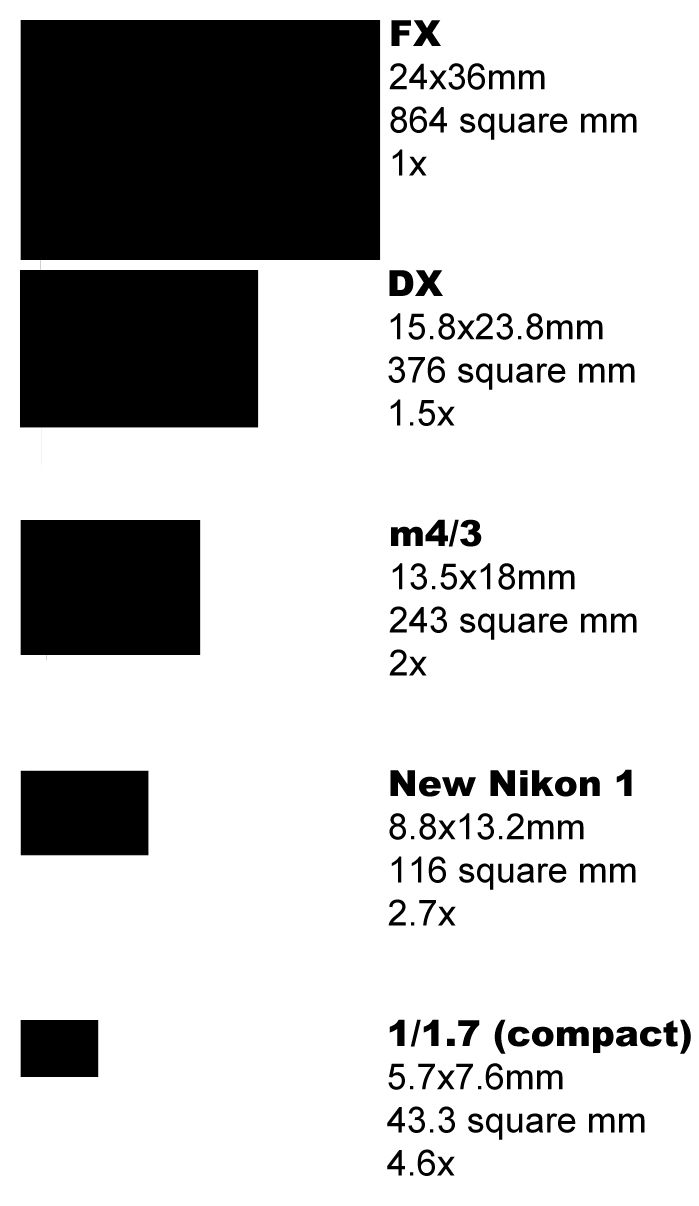
Nikon 1 also represents about a full stop step up from the largest compact sensor size commonly used, so it does indeed fill a missing gap in the stop-by-stop sensor progression. The question, of course, is whether that gap needed filling. I'll go out on a limb here since I haven't had a chance to use the new camera and say yes, the gap probably did need filling. Or maybe I should put it this way: Nikon needed something more competent than they've done so far with Coolpix but which doesn't cannibalize their DSLR lineup.
Unfortunately, this is Nikon once again aiming at the consumer electronics market, not the photography market. While the camera has some very respectable enthusiast touches to it (it can save raw files, for example), Nikon appears to be targeting the person not satisfied with camera phones and compact cameras more than they are the photo enthusiast who wants a camera they carry around with them all the time. That the controls are more P300-like than P7100-like are one giveaway.
I know there will be a lot of push-back on Nikon in the coming weeks. The missing D300s, D700, and D3s replacements are what the loyal Nikon user really wants to see. The 10mp count seems low, even with all the video who-haw. Another new lens set when we're still missing a number of DX lenses doesn't bode well for that problem going away. Plus there's this (wrong) perception that Sony now has lots of 24mp goodness and therefore trumps everyone.
Let be clear about a couple things. First, in terms of mirrorless systems, there's really only one reasonably complete system at the moment, and that's m4/3. An m4/3 user has a wide choice of lenses, accessories, and cameras. They perform quite well, and if you buy during the occasional Olympus or Panasonic fire sale on previous generation product, they cost less (and perform better) than a serious compact compact (G12, XZ-1, etc.). Sony's NEX system is let down by its lens choices, while Samsung's NX system is let down by its sensors (though I haven't tested the NX200 yet).
Yes, I know that you can put a legacy lens on a NEX-7. I can put legacy lenses on my D3s, too, but I don't do that a lot because there is an advantage to having full automation available. If someone wants to argue that the NEX-7 is total goodness when coupled with, oh, say my 58mm NOCT and a Nikon F-mount adapter, by all means make your argument. But it's not everyone's cup of tea. The majority of camera buyers are looking for complete, self-contained solutions that don't have any caveats or special dependencies. It's only the pixel freak, gotta be able to make 36" prints from my Flickr gallery crowd that needs 24mp.
The interesting thing about Nikon's new V1 and J1 cameras is this: they don't really have any direct competition. The Pentax Q is smaller (in sensor and form). Both m4/3 and NEX/NX are larger (in sensor and form), and tend to compete with low-end DSLRs more than high-end compacts. Nikon has managed to produce something different. Whether that sticks or not is another question. On paper, however, the V1 has a lot going for it that the P7100 doesn't.