Nikon continues its announcement-of-the-month tactic, this month with a few things that'll perk up some of the Nikon faithful. Maybe.
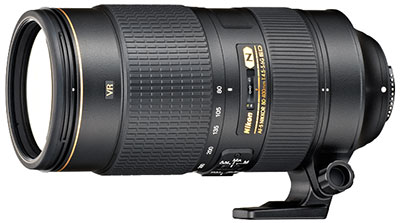
First up, we've got the long overdue 80-400mm refresh. The last lens that Nikon announced that wasn't AF-S was over 10 years ago, about two years after the 80-400mm originally shipped. Despite selling about 200,000 of these lenses--most in the AF-S era--Nikon seemed to drag its feet on ever creating the AF-S update. I count 25 lenses that got AF-S updates plus quite a few new lenses (14-24mm, 16-35mm, 24-120mm, 70-200mm f/4, and so on) that appeared before the 80-400mm finally got a built-in lens motor.
Rip Van Optical Winkle has finally awoke, though, and today Nikon announced the 80-400mm replacement. What's new in terms of specifications? The new VR system, AF-S, Nano coating, weather sealing basically. It's still 80-400mm and it's still f/4.5-5.6, though the optical formula is different and the published MTFs look much better. It's still a 77mm filter ring lens, with minimum focus of 5'9" (1.75m). With the D4, D600, D800, and upcoming D7100 cameras, you can use a TC-14E converter and still get focus. Weighing in at 3.3 pounds (1480g) and 8" in overall length collapsed, it's bigger and heavier than the original by a bit. Price is US$2700 and availability will happen later this month.
Along with the Awakening Zoom, we get two new Coolpix models, both interesting in some way. The P330 is easy to deal with: basically the update of the P310, now with raw file handling (yeh!) and a 12mp BSI 1/1.7" sensor with a 24-120mm (equivalent) f/1.8-5.6 lens out front. Weirdly, the P330 now has built-in GPS, but Nikon is playing up the optional WiFi more than the GPS in their marketing. Price is US$380 and it, too will be available soon.
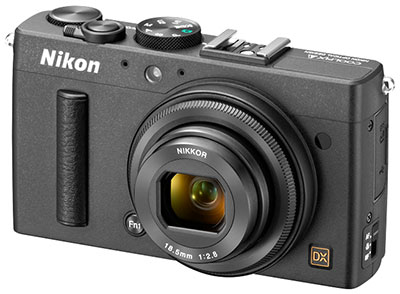
More interesting to many will be the Coolpix A, a DX sensor-based Coolpix, somewhat similar to the Coolpix Pro I suggested many years ago and went so far as specifying in 2007. DX sensor, check. Fixed 28mm focal length (equivalent) lens, check (though not trifocal as I suggested). f/2.8, check. Optical finder, sorta check as it's a US$450 option. Heck, I note that I even used the term Model A in that article ;~) (though not about the Nikon Coolpix). As I wrote six years ago, making a very compact camera with a DX-sized sensor is very doable. Unlike a lot of folk that responded to that article saying that it was impossible, Nikon managed to get pretty much to the size I suggested. Score one for the engineers.
Things that are probably going to bother some about the A model: no VR, no retro styling ala the Fujifilm X100, no phase detect AF, no commander mode on the flash, the small capacity of the EN-EL20 battery (230 images CIPA), the lack of an optical viewfinder (though it's an expensive option as I noted earlier), and the hybrid DSLR/Coolpix control system. On that last point, we have overloaded buttons, an Info button, a Mode dial, and a Rear Command dial ala the consumer DSLRs. But…the button most likely to be hit by your right thumb? That would be the Playback button, not the ISO/Fn2 button. Likewise, the exposure compensation button is to the left of the 3" LCD. It seems that Nikon is suggesting that you two-hand this small (4.4 x 2.6 x 1.6"), light (10.6 ounce, 299g) camera.
Both the P330 and the A (Canadians must love that name, eh?) can use the WU-1a WiFi adapter. The A can use modern CLS Speedlights.
Ah, but Nikon marketing, does it exist?
Nikon has now used the letters A, D, J, L, N, S, V, and X, and all the numbering except 5, 6, 7, 8, 9, 400, 900, 1000, and 2000. Actually, I think they have used some of those numbers, too, but not for a long time, so maybe we've forgotten what they mean and they can be reused.
For the most part, Nikon's naming conventions work only if you have the full decoding guide to the couple hundred models in the last 10 years and have a penchant for being anal. Even then there are confusions. Is an S9xxx better than a D7xxx? Are the 1 and the 4 related? What happened to the high-end double digits, oh wait, some of the low-end Coolpix now use double digits. From a marketing standpoint it makes absolutely no sense unless you're trying to confuse the customer (and the store sales people, and virtually everyone).
Simply put, the Coolpix A should probably have been the Coolpix DX-1 or maybe DX-A. Oh, wait, that's too logical, as DX actually means something. Right, my point exactly. The lineup is a mess. They need a name for cameras with built-in lenses (Coolpix) and a name for cameras with interchangeable lenses (let's call them Versapix just for the purposes of this discussion). Then you have:
Coolpix AX-model numbers = smallest sensor
Coolpix BX-model numbers = 1/2.3" sensor
Coolpix CX-model numbers = 1" sensor
Coolpix DX-model numbers = APS sensor
Coolpix FX-model numbers = 35mm film sized sensor
Versapix CX-model numbers = 1" sensor
Versapix DX-model numbers = APS sensor
Versapix FX-model numbers = 35mm film sized sensor
If you also make your model numbers mean something (single digit = pro, double digit = prosumer, triple digit = high consumer, quadruple digit = consumer), suddenly the product name tells you everything you need to know about where it fits in the lineup. Heck, we even have room for my communicating, programmable, modular cameras (Smartpix CX, DX, FX), and for a line of video cameras (Videopix BX, CX, DX, FX).
Of course, to have done that type of identification, you'd have had to have known where you were steering the products in the first place. But really, Nikon, how hard was it to figure out that you'd have different sensor sizes and different body types at different levels? This isn't brain surgery, it's marketing, after all. The naming wing of the Nikon marketing department is like the floor painter who paints themselves into a corner, waits for the paint to dry, then paints themselves across the room into a different corner. Let's hope someone's getting them food and water.
I need to get back to my Versapix FX600 and DX7100 books, so for now that's all I'm going to write.