A common question I get concerns the weather seals on Nikon's equipment. The usual question concerns whether the pro-level bodies can be used in rain, snow, and sleet. Probably for legal reasons, Nikon seems to no longer publish their specifications for ingress rejection. I seem to remember somewhere that it was about a quarter inch of rain an hour, but don't quote or trust me on that; my point is that Nikon has some level of expectation of what the cameras can resist. The issue has always been trying to figure out how that works in real life.
I can only tell you about my experience. But photographing bison last month in Yellowstone, at one point I left my camera for a few minutes and this was the result:
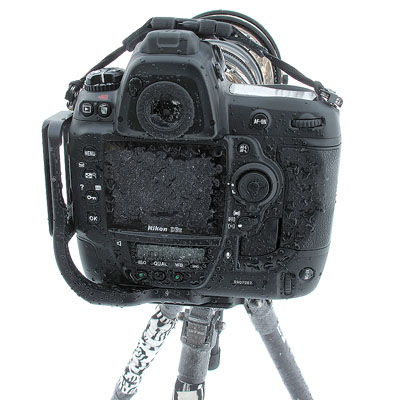
In case it isn't obvious, we're in near white-out conditions (thus the lack of background when the camera is properly exposed). Here's a closer look at a portion of the picture (50% view):
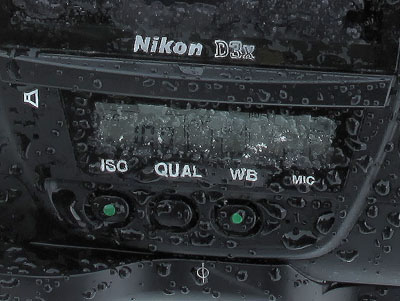
And, yes, the camera still functions fine. I did, however, dry it off immediately upon re-entering the snow coach, and I did a thorough cleaning that evening just to make sure there was no lingering moisture.
My rule of thumb on the Nikon pro equipment has always been this: if I can keep the eyepiece and lens free from moisture and condensation enough to frame and focus, then the camera is likely to survive whatever conditions I'm working in. If I'm having to clear the lens and eyepiece at regular intervals to keep working, I'll put the camera and lens in some sort of protection (usually my lightweight Kata waterproof bag). Normally, it's the lens that stops me. In blowing or heavy rain you just can't keep the front element of the lens clean enough to keep taking pictures. The only way to work in that kind of situation is via heavy-duty rain covers, ones that extend well out past the front of even the lens hood.
All that said, my recommendation to you is tougher. I've seen LCDs get damaged by even light drizzle on the D200 through D700 type bodies (water seeps in behind the outer glass), and I've heard of NikonUSA rejecting repairs on weather-sealed cameras that show corrusion inside. It's not that difficult or expensive to get some inexpensive protection. I usually have a lightweight non-camera specific rain cover clipped to my bag (Tamrac, Tenba, and others make inexpensive models, many of which come with small carrying pouches that can be easily clipped to the bag), and I can always use the rain cover for my Think Tank bag in an emergency (assuming, of course, that I can keep the bag itself in a vehicle or out of the rain). If it's more than mist (i.e. even a light drizzle), I'd recommend you use a simple cover like these. Also, if the mist is not pure water (e.g. sea spray or volcanic mist), I'd suggest that you use protection. Better safe than sorry. Corrosion inside the camera can be very expensive to repair (if it can be done at all).
Ditto for lenses. On my long lenses (that's the 400mm f/2.8 in the photo, above) I keep LensCoats on them, which helps, but once the moisture is constant I'll usually put on my heavy duty Aquatech cover.
Maybe you're worried about less weather worthy cameras, such as the Canon G10:
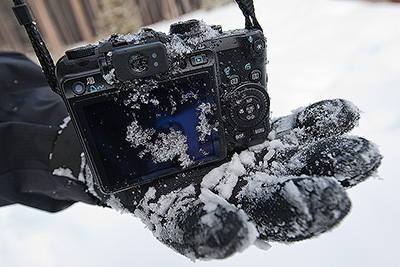
Similar answer, with a twist. The G10 seems to survive the elements well, except the lens is very vulnerable when extended.
Bottom line: carry protection and use it.